
UC Berkeley’s Philippine Studies Program Conducts 2nd Brother Andrew Gonzalez Lecture on Philippine Art and History
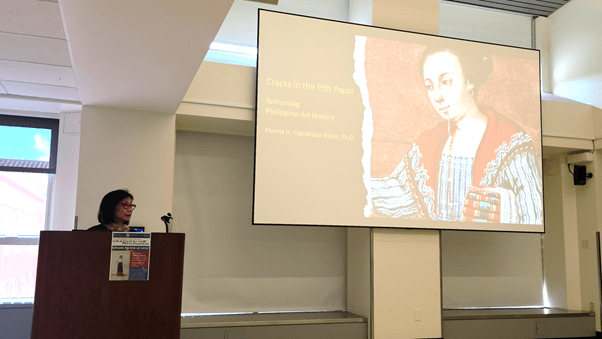
Dr. Florina H. Capistrano-Baker presents previously understudied practice of Chinese replication of early- to mid-nineteenth-century Philippine export paintings known as tipos del pais, or the popularized artworks in the Philippines that typically depict local inhabitants and their costumes (San Francisco PCG photo)
Berkeley, California – On 22 April 2026, Dr. Florina H. Capistrano-Baker, former Director of the Ayala Museum, delivered a lecture titled, Cracks in the Pith Paper: Reframing Philippine Art History at Dwinelle Hall at the University of California, Berkeley.
The lecture was organized by the Center for Southeast Asia Studies of the Institute of East Asian Studies (CSEAS) in collaboration with graduate students of the Philippine Studies group at UC Berkeley. It was held as part of the 2025 grant given by the Department of Foreign Affairs to promote Philippine Studies at the university.
Dr. Capistrano-Baker’s lecture examined the previously understudied practice of Chinese replication of early- to mid-nineteenth-century Philippine export paintings known as tipos del pais, popularized artworks in the Philippines that typically depict local inhabitants and their attires. By situating Manila-produced watercolors alongside Cantonese workshop copies executed on pith paper–works that were traditionally attributed or misattributed to the Filipino artist Damian Domingo (ca. 1796–1834)–the lecture illuminated a complex, layered system of replication that challenges conventional distinctions between “original” and “copy.”
She argued that these works should not be understood within a binary framework of authenticity versus imitation. Rather, they reveal a dynamic process of artistic production shaped by cross-cultural exchange, commercial demand, and workshop practices across maritime Asia. The replication of tipos del pais in Cantonese studios reflects not only the circulation of visual models but also the adaptation of imagery to suit different markets. In this context, copies functioned as active agents in the dissemination and transformation of visual knowledge, complicating assumptions about authorship, originality, and artistic value.
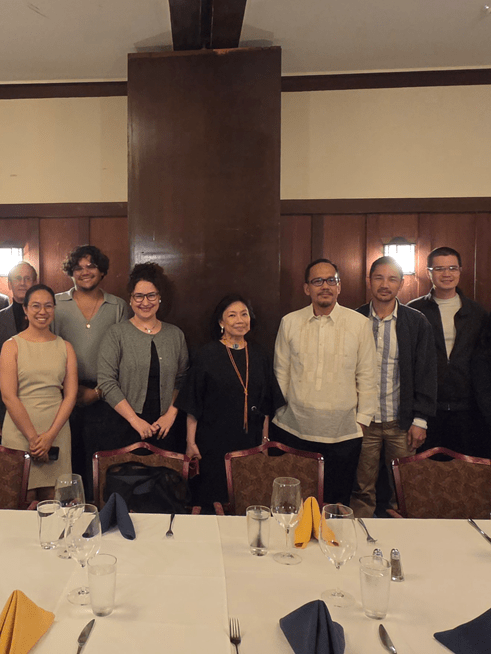
Dr. Florina H. Capistrano-Baker (5th from the left), Consul General Arnel G. Talisayon (3rd from the right), and Dr. Lisandro Claudio (2nd from the right), with some UC Berkeley students and faculty members who attended the lecture (San Francisco PCG photo)
During the dinner hosted by CSEAS, Dr. Capistrano-Baker, UC Berkeley representatives, and consulate officials had informal conversations about the role and importance of art in helping shape national identities.
The conversations highlighted, among other topics, the influence of Philippine traditions and practices on other cultures, including on Chinese and Mexican contexts, such as how the practice of fermenting palm wine (tuba) in the Philippines had an impact on Mexico’s own process—substantial exchanges of technique and information that demonstrated practical and dynamic interaction between the two Spanish colonies.
Inputs from the lecture and the dinner would inform the Consulate’s planned cultural activities, as part of its continued promotion of Philippine art, culture, and history under the Philippine Studies program.
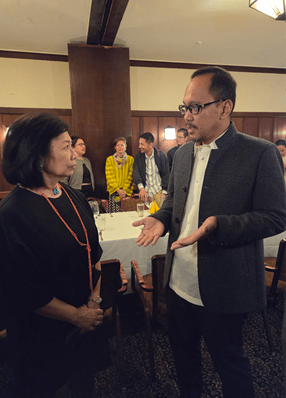
Dr. Florina H. Capistrano-Baker with Consul General Arnel G. Talisayon
The Consulate took the opportunity to thank Dr. Florina H. Capistrano-Baker for her lecture and for presenting diverse perspectives through which Philippine art history may be examined and actively inspire others to continue exploring Philippine art and culture. The Consulate also expressed appreciation to the program’s lead coordinator, Dr. Lisandro Claudio, and to the CSEAS for their interest in Philippine Studies.
Part of the country’s cultural promotion initiatives, the Consulate’s partnership with UC Berkeley aims to contribute to increased understanding of the Philippines and builds on earlier collaboration, including a 2024 program of Senator Loren Legarda. The program’s flagship project, the Annual Andrew Gonzalez Lecture–named after UC Berkeley alumnus, linguist, university president, and former Secretary of Education, Brother Andrew Gonzalez, FSC–features lectures delivered by eminent figures in Philippine arts and letters based in the Philippines, further enriching engagements among Philippine Studies graduate students in the United States. END