
CIVIL REGISTRY
General Information
In order to register the birth, marriage or death abroad of a Filipino to the Philippine Statistics Authority (PSA) to the Philippines, it should be reported to the Philippine Embassy/Consulate General having jurisdiction over where the vital event took place.
The consular jurisdiction of the Philippine Consulate General in San Francisco is as follows: Alaska, Idaho, Oregon, Washington State, Northern Nevada (covering the city of Carson and the counties of Churchill, Douglas, Elko, Esmeralda, Eureka, Humboldt, Lander, Lyon, Mineral, Pershing, Storey, Washoe, and White Pine), Colorado, Montana, Utah, Wyoming, and Northern California (covering the counties of Alameda, Alpine, Amador, Butte, Calaveras, Colusa, Contra Costa, Del Norte, El Dorado, Fresno, Glenn, Humboldt, Inyo, Kings, Lake, Lassen, Madera, Marin, Mariposa, Mendocino, Merced, Modoc, Mono, Monterey, Napa, Nevada, Placer, Plumas, Sacramento, San Benito, San Francisco, San Joaquin, San Mateo, Santa Clara, Santa Cruz, Shasta, Sierra, Siskiyou, Solano, Sonoma, Stanislaus, Sutter, Tehama, Trinity, Tulare, Tuolumne, Yolo, and Yuba).
Applications are to be filed by mail to
The Philippine Consulate General, Attn: Civil Registry Section, 447 Sutter Street, San Francisco 94108.
The applicant must report the vital event to the Philippine Embassy or Consulate General that has jurisdiction over the place where the event occurred. Click here to view which Consulate has jurisdiction in a particular location. If you wish to submit your documents in person at the Consulate, please click the button below to schedule an appointment. Please note that incomplete applications may not be accepted by the Consulate.
IMPORTANT NOTE:
Philippine nationals, regardless of status, are eligible to avail themselves of consular services. Supporting documents like a permanent resident card may be presented only to help establish that a Filipino national has not yet lost Philippine citizenship at the time of the vital event. Other supporting documents may be presented. Consulate officials can assist eligible individuals who have lost Philippine citizenship, but wish to reacquire/retain their Philippine citizenship.
Procedure and Requirements
A child born in the United States may file a Report of Birth in order to be recognized as a Filipino citizen and considered as a dual citizen at birth under the following conditions:
- BORN BEFORE 17 JANUARY 1973
- If parents are married, the father must be a Filipino citizen at the time of the child’s birth.
- If parents are NOT married, the mother must be a Filipino citizen at the time of the child’s birth.
- CHILD BORN ON OR AFTER 17 JANUARY 1973: (1) Either or both the father or mother must be a Filipino citizen at the time of the child’s birth; or (2) The child was included as a derivative dual citizen when the father or mother reacquired/retained dual citizenship under R.A. 9225.
A. DOCUMENTARY REQUIREMENTS
Ensure all documents are complete before mailing your application to avoid delays in processing. The Consulate reserves the right to return incomplete applications.
- Cover Letter
- Indicate the service requested
- Write your name and contact information (mobile number and email address)
- List of the enclosed documents
- Report of Birth Forms
- Four (4) original Report of Birth Forms (signed and notarized by a notary public after completion of pre-assessment).
- Must be printed/typewritten. Handwritten documents will not be accepted.
- Birth Certificate
- One (1) original and four (4) photocopies of the child’s foreign birth certificate.
- Parents’ Passport
- Four (4) photocopies of both parents’ valid passport data page.
- Other Proof of Parent’s Filipino Citizenship, if applicable:
- Four (4) photocopies of Filipino parent’s proof of Philippine citizenship at the time of birth of the child including any of the following sample documents:
- U.S. permanent resident card, visa or permit; or
- Dual citizenship Identification Certificate, Oath of Allegiance and Order of Approval; or
- Other supporting documents (examples: voter’s ID, active voter registrations, UMID, SSS ID, PHL National ID, etc.)
- Four (4) photocopies of Filipino parent’s proof of Philippine citizenship at the time of birth of the child including any of the following sample documents:
B. OTHER REQUIREMENTS DEPENDING ON SPECIFIC CIRCUMSTANCES
DELAYED REGISTRATION
- Affidavit of Delayed Registration If Child’s Birth is Reported More Than A Year After They Were Born
One (1) original and three (3) photocopies of a notarized affidavit explaining the delayed registration.
FOR LEGITIMATE CHILDREN
- Marriage Certificate for Parents Married at the Time of Birth
One (1) original and four (4) photocopies of the marriage certificate issued by the Philippine Statistics Authority (PSA) or a foreign marriage certificate.
Note: A marriage certificate issued by the PSA can be ordered online through psahelpline.ph.
FOR LEGITIMATED CHILDREN
- Joint Affidavit of Legitimation for Parents Married After the Child’s Birth
One (1) original and three (3) photocopies of the notarized affidavit.
FOR ILLEGITIMATE CHILDREN AND USING FATHER’S SURNAME
- Affidavit of Admission of Paternity (AAP) for Unmarried Parents Where the Father will Acknowledge the Child
One (1) original and three (3) photocopies of the notarized affidavit executed by the father.
- Affidavit to Use the Surname of the Father (AUSF)
- One (1) original and three (3) photocopies of the notarized affidavit.
- (IF CHILD IS BELOW 7 YEARS OLD) – Executed by the mother.
- (IF CHILD IS 7-17 YEARS OLD) – Executed by the child with SWORN ATTESTATION executed by the mother or guardian
- (IF CHILD IS 18 YEARS OLD AND ABOVE) – Executed by the child.
FOR CHILDREN INCLUDED IN THE PARENTS’ DUAL CITIZENSHIP PETITION AS DERIVATIVE
- Four (4) photocopies of the parents’ and child’s dual citizenship Identification Certificate, Oath of Allegiance and Order of Approval.
*The Consular Officer reserves the right to require additional documents from the informant or applicant.
C. APPLICATION PROCESS
- Accomplish, scan and send your documents to the Civil Registry’s email at [email protected] for pre-processing before submitting your documents by mail.
- Once documents have been determined to be complete and in order, have the documents signed and notarized at a notary public.
- Secure a self-addressed stamped envelope, preferably USPS Priority Mail Flat Rate Envelope with stamps and tracking number. Send the documents by mail to the following address:
Philippine Consulate General
Attn: Civil Registry Section
447 Sutter Street, 6th floor
San Francisco, California 94108, USA
NOTE: The Philippine Consulate General assumes no responsibility for any delay or loss in the mail, or while the documents are in the custody of the courier service. The applicant should note the tracking numbers of all envelopes used and submitted, and may track their envelopes at the website of their chosen courier.
D. PAYMENT
- Report of Birth processing fee – S25.00.
- Certificate of Registration of Legal Instrument (for those who will execute AAP, AUSF, and Sworn Attestation) – $25.00 for each Legal Instrument.
- Registration / Notarization of AAP / AUSF / and Sworn Attestation – $25.00 each.
*Payment should be in the form of a money order or cashier’s check payable to the Philippine Consulate General. Do not send cash by mail.
E. WHEN WILL I GET MY BIRTH CERTIFICATE?
It takes about six months to one year from filing a Report of Birth for the Philippine Statistics Authority (PSA) to issue an official birth certificate on security paper with a barcode. Once available, you may request a copy online at https://www.psaserbilis.com.ph/, which can be delivered to your US address.
Marriages between Filipinos, or between a Filipino and a foreign national, must be reported and registered with the Philippine Statistics Authority (PSA) through the Philippine Embassy or Consulate General that has jurisdiction over the place of marriage.
A. DOCUMENTARY REQUIREMENTS
Ensure all documents are complete before mailing your application to avoid delays in processing. The Consulate reserves the right to return incomplete applications.
- Cover Letter
- Indicate the service requested.
- Write your name and contact information (mobile number and email address).
- List of the enclosed documents.
- Report of Marriage Forms
- Four (4) original Report of Marriage forms (signed and notarized by a notary public after completion of pre-assessment).
- Must be printed/typewritten. Handwritten documents will not be accepted.
- Marriage Certificate issued by US vital records
- One (1) original and four (4) photocopies of the foreign marriage certificate indicating information on the number of marriages contracted by both parties. If unindicated, please submit Marriage Record/License as an additional requirement.
- For Marriages Celebrated Online in Utah, the marriage license/certificate must be Apostilled by the Utah Lieutenant Governor.
- For Marriages Celebrated via Proxy in Montana, the marriage license/certificate must be Apostilled by the Montana Secretary of State.
- For Self-Solemnized Marriages Celebrated in Colorado, the marriage license/certificate must be Apostilled by the Colorado Secretary of State.
- Birth Certificates
- If both spouses are Filipino, four (4) photocopies of the spouses birth certificates issued by the Philippine Statistics Authority (PSA)
- If one spouse is foreign, four (4) photocopies of the Foreign birth certificate of the foreign spouse and (4) photocopies of the PSA birth certificate of the Filipino spouse.
- Passport
- Four (4) photocopies of both spouses valid passport data page
- PSA Certificate of No Marriage (CENOMAR)
- CENOMAR issued by the Philippine Statistics Authority, for the Filipino spouse/s
- Other Proof of Philippine Citizenship of at least one of the parties, if applicable:
- Four (4) photocopies of Filipino spouse’s proof of Philippine citizenship at the time of marriage including any of the following sample documents:
- U.S. permanent resident card, visa or permit; or
- Dual citizenship Identification Certificate, Oath of Allegiance and Order of Approval; or
- Other supporting documents (examples: voter’s ID, active voter registrations, UMID, SSS ID, PHL National ID, etc.)
- Four (4) photocopies of Filipino spouse’s proof of Philippine citizenship at the time of marriage including any of the following sample documents:
B. OTHER REQUIREMENTS IN CASES OF DIVORCE, ANNULMENT OR DEATH OF A PREVIOUS SPOUSE
If Marriage is Reported More than After a Year
- One (1) original and three (3) photocopies of a notarized affidavit of delayed registration.
In Cases of Divorce, Annulment or Death of a Previous Spouse
- Judicial Decree of Annulment or Divorce (if Filipino Spouse is Annulled)
- Four (4) photocopies of Judicial Decree of Annulment/Absolute Divorce, with Certificate of Finality issued by Philippine court, Annotated PSA Marriage Certificate from the Philippines
- Divorce Decree (if Foreign Spouse is divorced)
- Four (4) photocopies of the divorce decree
- Death Certificate (if Filipino/Foreign spouse is widowed/widower)
- Four (4) photocopies of the death certificate
*The Consular Officer reserves the right to require additional documents from the informant or applicant.
C. APPLICATION PROCESS
- Accomplish, scan and send your documents to the Civil Registry’s email at [email protected] for pre-processing before submitting your documents by mail.
- Once documents have been determined to be complete and in order, have the documents signed and notarized at a notary public.
- Secure a self-addressed stamped envelope, preferably USPS Priority Mail Flat Rate Envelope with stamps and tracking number. Send the documents by mail to the following address:
Philippine Consulate General
Attn: Civil Registry Section
447 Sutter Street, 6th floor
San Francisco, California 94108, USA
NOTE: The Philippine Consulate General assumes no responsibility for any delay or loss in the mail, or while the documents are in the custody of the courier service. The applicant should note the tracking numbers of all envelopes used and submitted, and may track their envelopes at the website of their chosen courier.
D. PAYMENT
- USD 25.00 processing fee for Report of Marriage.
- Payment should be in the form of money order or cashier’s check payable to the “Philippine Consulate General”.
- All fees are non-refundable.
E. WHEN WILL I GET MY MARRIAGE CERTIFICATE?
It takes about six months to one year from filing a Report of Marriage for the Philippine Statistics Authority (PSA) to issue an official marriage certificate on security paper with a barcode. Once available, you may request a copy online at the PSA Helpline website, which can be delivered to your US address.
There is no divorce in the Philippines, but when a divorce is validly obtained abroad by an alien spouse from his or her Filipino spouse, the Filipino spouse shall have the capacity to remarry under Philippine law. However, the divorce obtained abroad must be passed upon judicially by a Philippine court to prove its validity before the Filipino spouse can remarry under Philippine law.
The decision of the Philippine Court shall become the basis for the annotation of civil registry documents.
The following guidelines shall be followed in the annotation of the foreign-issued divorce decree with the Office of the Civil Registrar General in the Philippines:
1. The foreign divorce decree must be judicially enforced or confirmed in the Philippines by filing the proper civil action at the Regional Trial Court in the Philippines (RTC-Phil).
2. The court decision shall be registered in the Local Civil Registry Office (LCRO) where the concerned RTC-Phil functions.
3. The registered document shall be submitted to the Local Civil Registrar where the marriage is registered. If the marriage was registered overseas, the registered document shall be submitted to the City Civil Registry Office at the Manila City Hall (CCRO Manila).
4. The following documents shall be submitted to CCRO Manila in annotating a civil registry document:
a. Original or Certified True Copy of the foreign judgment or order duly registered at the City Civil Registry Office at the Manila City Hall (CCRO Manila).
b. Original or Certified True Copy of the Certificate of Finality of the decision of Regional Trial Court (RTC-Phil).
c. Certificate of Registration of the decision of Regional Trial Court (RTC-Phil) at the Local Civil Registry Office (LCRO) where the concerned RTC-Phil functions.
5. After the annotation at the Local Civil Registrar’s Office (LCRO), the annotated documents and its requirements must be submitted to the Office of the Civil Registrar-General (OCRG) in Manila.
NOTE: All official documents sourced or obtained in United States and intended for use and submission to Philippine authorities must be apostillized by the issuing State/Competent Authority in order for said documents to have any legal effect in the Philippines. For more information on how to secure an Apostille Certificate, please visit the link at Notarial Services.
More information about the legal procedures or hiring the services of a lawyer in the Philippines may be obtained from the Integrated Bar of the Philippines (IBP) or the Public Attorneys’ Office (PAO) in Manila.
INTEGRATED BAR OF THE PHILIPPINES (IBP)
IBP Building
No. 15 Julia Vargas Avenue
Ortigas Center, Pasig City
Metro Manila, Philippines.
Tel: (+63-2) 631-3014 or 631-3018
Email: [email protected] or [email protected]
Website: www.ibp.ph
PUBLIC ATTORNEY’S OFFICE (PAO)
4th and 5th Floors
DOJ Agencies Building
NIA Road corner East Avenue
Diliman, Quezon City
Metro Manila, Philippines.
Tel: (+63-2) 929-9436
Email: [email protected]
Website: www.pao.gov.ph
The death of a Filipino national must be reported and registered with the Philippine Statistics Authority (PSA) through the Philippine Embassy or Consulate with jurisdiction over the place of death.
A. DOCUMENTARY REQUIREMENTS
- Cover Letter
- Indicate the service requested.
- Write your name and contact information (mobile number and email address).
- List of the enclosed documents.
- Report of Death Forms
- Four (4) original Report of Death forms (signed and notarized by a notary public after completion of pre-assessment).
- Must be printed/typewritten. Handwritten documents are not accepted.
- Death Certificate
- One (1) original and four (4) photocopies of the U.S. Certificate of Death issued by the state’s Department of Health.
- Philippine Identification Documents
- Four (4) photocopies of the latest Philippine passport of the deceased.
- Other Proof of Philippine citizenship of the Filipino national at the time of death, if applicable:
- Four (4) photocopies of any of the following sample documents:
- U.S. permanent resident card, visa or permit; or
- Dual citizenship Identification Certificate, Oath of Allegiance and Order of Approval; or
- Other supporting documents (examples: voter’s ID, active voter registrations, UMID, SSS ID, PHL National ID, etc.)
- Four (4) photocopies of any of the following sample documents:
B. APPLICATION PROCESS
- Accomplish, scan and send your documents to the Civil Registry’s email at sanfranciscopcg.[email protected] for pre-processing before submitting your documents by mail.
- Once documents have been determined to be complete and in order, have the documents signed and notarized at a notary public.
- Secure a self-addressed stamped envelope, preferably USPS Priority Mail Flat Rate Envelope with stamps and tracking number. Send the documents by mail to the following address:
Philippine Consulate General
Attn: Civil Registry Section
447 Sutter Street, 6th floor
San Francisco, California 94108, USA
NOTE: The Philippine Consulate General assumes no responsibility for any delay or loss in the mail, or while the documents are in the custody of the courier service. The applicant should note the tracking numbers of all envelopes used and submitted, and may track their envelopes at the website of their chosen courier.
D. PAYMENT
- USD 25.00 processing fee for Report of Death.
- Payment should be in the form of money order or cashier’s check payable to the “Philippine Consulate General”.
- All fees are non-refundable.
WHEN WILL I GET THE DEATH CERTIFICATE?
It takes about six months to one year from filing a Report of Death for the Philippine Statistics Authority (PSA) to issue an official death certificate on security paper with a barcode. Once available, you may request a copy online at the PSA Helpline website, which can be delivered to your US address.
Consular Mortuary Certificates are issued for the transportation of remains or the cremated remains of a deceased individual to the Philippines.
NOTE:
- All documents must be received at least two (2) weeks before the flight of the remains or cremains.
- The Philippine Consulate General assumes no responsibility for any delay or loss in the mail, or while the documents are in the custody of the courier service. The applicant should note the tracking numbers of all envelopes used and submitted, and may track their envelopes at the website of their chosen courier.
HOW TO APPLY
- Complete your required documents and send them to the Civil Registry’s email at sanfranciscopcg.[email protected] for pre-processing before submitting your documents by mail.
- After pre-processing, send your documents by mail with the complete documentary requirements to the following address:
Philippine Consulate General
Attn: Civil Registry Section
447 Sutter Street, 6th floor
San Francisco, California 94108, USA
DOCUMENTARY REQUIREMENTS
Please make sure all your documents are complete before mailing your application to avoid delays in processing. The Consulate reserves the right to return incomplete applications.
A. FOR HUMAN REMAINS:
- Cover Letter
- Indicate the service request for a Consular Mortuary Certificate.
- Write your name and contact information (mobile number and email address)
- List of the enclosed documents
- Death Certificate
- One (1) original and two (2) photocopies of the U.S. Certificate of Death issued by the State Department of Health. The original death certificate shall be returned with the processed Consular Mortuary Certificate.
- Itinerary / Flight Details
- Three (3) photocopies of the itinerary to include full flight details and mode of transportation.
- Identification Card
- Three (3) photocopies of the deceased’s government-issued identification card.
- Certificate Issued by the Mortuary Director
- One (1) original and Two (2) photocopies of the Notarized Certificate issued by the Mortuary Director that the body was properly embalmed and that the casket contains only the body of the deceased.
- Certificate of No Contagious Disease
- One (1) original and Two (2) photocopies of the Certificate of No Contagious Disease issued by the State Department of Health.
- Burial Transit Permit
- One (1) original and Two (2) photocopies of the Burial Transmit Permit.
- Funeral Company in the Philippines
- Three (3) photocopies in written form provide the name, address, and contact number of the receiving funeral company in the Philippines.
- Self-Addressed Stamped Envelope
- (FOR US RESIDENTS ONLY) – One (1) self-addressed stamped envelope, preferably USPS Priority Mail Flat Rate Envelopewith stamps and tracking number.
- Processing Fee (All Fees are non-refundable)
- Consular Mortuary Certificate processing fee – S25.00.
- Payable to “Philippine Consulate General” in Money Order, Certified Check, or Cashier’s Check.
- Personal checks are not accepted.
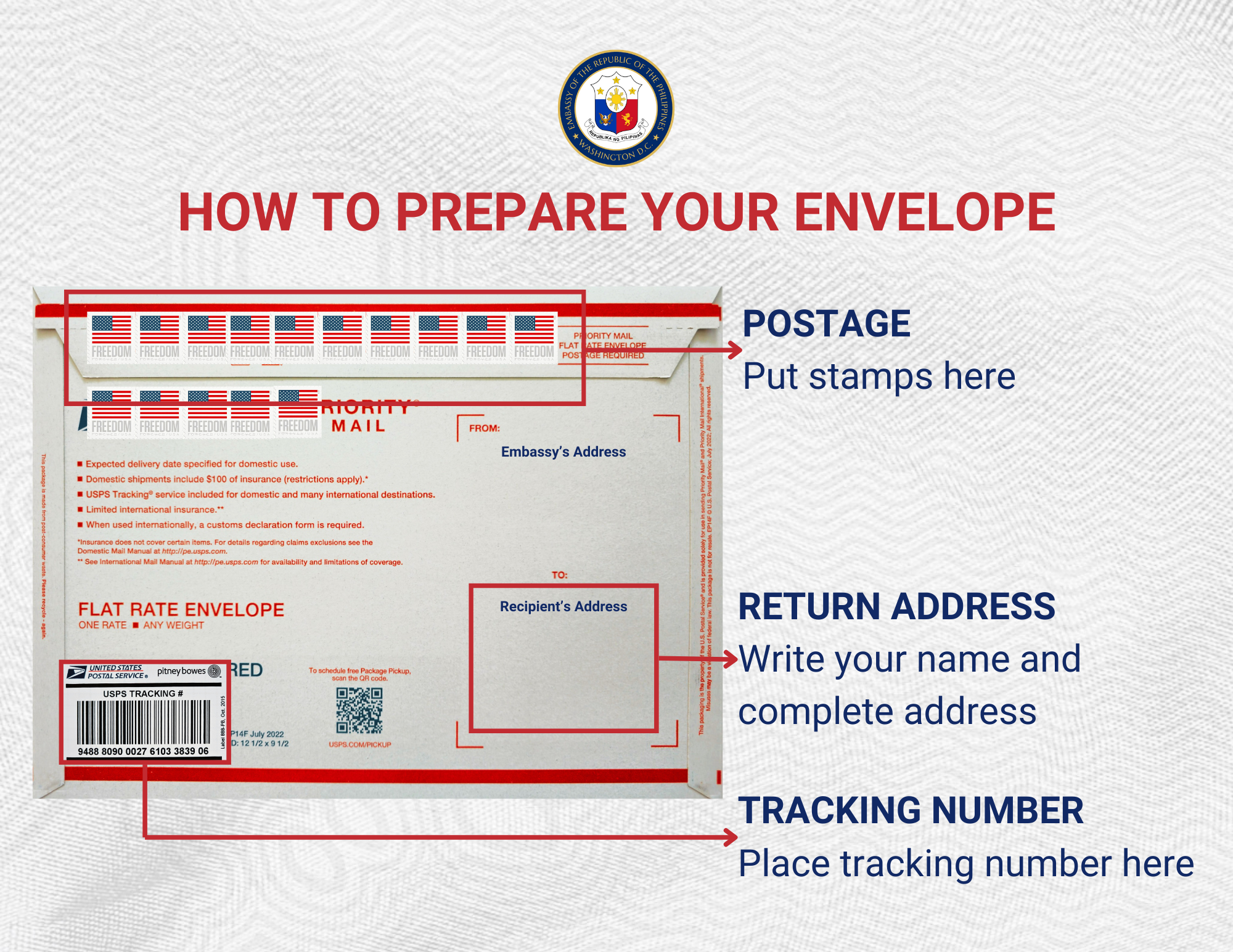
B. FOR CREMATED REMAINS:
- Cover Letter
- Indicate the service request for a Consular Mortuary Certificate.
- Write your name and contact information (mobile number and email address)
- List of the enclosed documents
- Death Certificate
- One (1) original and two (2) photocopies of the U.S. Certificate of Death issued by the State Department of Health. The original death certificate shall be returned with the processed Consular Mortuary Certificate.
- Itinerary / Flight Details
- Three (3) photocopies of the itinerary to include full flight details and mode of transportation.
- Identification Card
- Three (3) photocopies of the deceased’s government-issued identification card.
- Certificate Issued by the Mortuary Director
- One (1) original and Two (2) photocopies of the Notarized Certificate issued by the Mortuary Director that the body was properly cremated and that the urn contains only the body of the deceased.
- Certificate of Cremation
- One (1) original and Two (2) photocopies of the Certificate of Cremation issued by the Crematory.
- Burial Transit Permit
- One (1) original and Two (2) photocopies of the Burial Transmit Permit.
- Person Who Will Travel with the URN
- Three (3) photocopies of valid Identification documents (passport, driver’s license, etc.) of the person who will travel with the urn. Please indicate the relationship to the deceased person (spouse, father, mother, etc.).
- Self-Addressed Stamped Envelope
- (FOR US RESIDENTS ONLY) – One (1) self-addressed stamped envelope, preferably USPS Priority Mail Flat Rate Envelope with stamps and tracking number.
- Processing Fee (All Fees are non-refundable)
- Consular Mortuary Certificate processing fee – S25.00.
- Payable to “Philippine Consulate General” in Money Order, Certified Check, or Cashier’s Check.
- Personal checks are not accepted.
REMINDER: FOR UNACCOMPANIED CREMATED REMAINS, SUBMIT A STATEMENT FROM THE PERSON WHO WILL PICK UP THE URN IN THE PHILIPPINES.
NOTE:
- TO HELP US PROCESS YOUR APPLICATION SMOOTHLY, KINDLY COLLATE THE DOCUMENTS IN FOUR (4) SETS BY THE ORDER LISTED IN THE REQUIREMENTS.
- INCOMPLETE APPLICATIONS WILL BE RETURNED TO THE SENDER.
Under Republic Act 9048, as amended by Republic Act 10172, Filipinos abroad may file a petition before the Philippine Consulate General in San Francisco to correct a clerical or typographical error in an entry in the Civil Register without the need for a judicial order.
An appointment is required for this service. Email the Civil Registry Section at [email protected] to set up an appointment.
RA 9048, as amended by R.A. 10172, allows the correction of clerical or typographical errors in any entry in civil registry documents. A clerical or typographical error refers to an obvious mistake committed in clerical work, either in writing, copying, transcribing, or typing an entry in the civil register that is harmless and innocuous, such as the following:
- A misspelled name or misspelled place of birth, and the like, can be corrected or changed only by reference to other existing record or records
- Day and/or month of birth
- Gender/sex (provided that this correction is not a result of a sex reassignment)
Who may file the Petition?
The petition may be filed by a person of legal age who must have a direct and personal interest in the correction of the error in the civil register, such as the:
- The owner of the record that contains the error to be corrected or the first name to be changed
- Owner’s spouse, children, parents, brothers, sisters, grandparents, guardian, or any other person duly authorized by law or by the owner of the document sought to be corrected.
- A person is considered of legal age when he is eighteen years old and above. Thus, a minor (less than eighteen years old) cannot file a petition.
Where should the petition be filed?
The general rule is that a petition shall be filed with the Local Civil Registry Office (LCRO) where the record containing the clerical error to be corrected is kept. Included in this general rule is the case of the Office of the Clerk of Shari’a Court, where records of divorces, revocations of divorces, and conversions to Islam are kept, and where some Muslim marriages are registered.
However, in case the petitioner is a migrant within or outside the Philippines, meaning his present residence or domicile is different from where his civil registry record or records are registered, he may file the petition in the nearest LCRO in his area or the Philippine Consulate General if abroad. His petition will be treated as a migrant petition.
How much is the fee for filing a petition?
The C/MCR and the District/Circuit Registrar (D/CR) are authorized to collect from every petitioner One Thousand Pesos (P1,000.00) for the correction of clerical error. In the case of a petition filed with the Consul General (CG), the fee is fifty US dollars ($50.00) for the correction of a clerical or typographical error. The said fee is the same for all Philippine Consulates.
A migrant petitioner shall pay an additional service fee of Five Hundred Pesos (P500.00) for the correction of a clerical or typographical error to the Petition Receiving Civil Registrar (PRCR). This service fee shall accrue to the local treasury of the PRCR.
BASIC REQUIREMENTS TO FILE A PETITION FOR CORRECTION OF CLERICAL OR TYPOGRAPHICAL ERROR
Petition is in the prescribed form of an AFFIDAVIT that:
Must be subscribed and sworn to before any person authorized by law to administer an oath.
Set forth facts necessary to establish the merits of the petition.
Show affirmatively that the petitioner is competent to testify to the matters stated.
State the particular erroneous entry or entries sought to be corrected and the correction to be made.
In case of correction of DAY AND/OR MONTH in the date of birth or SEX of a person, the petition shall be supported with the following documents:
- Earliest school record or earliest school documents;
- Medical records;
- Baptismal certificate and other documents issued by religious authorities;
- A clearance or a certification that the owner of the document has no pending administrative, civil, or criminal case, or no criminal record, which shall be obtained from the following:
- Employer, if employed;
- National Bureau of Investigation; and
- Philippine National Police.
- Affidavit of Publication from the publisher and a copy of the newspaper clipping.
The petition must be supported with the following documents:
- A certified true machine copy of the certificate or of the page of the registry book containing the entry or entries sought to be corrected or changed;
- At least two (2) public or private documents showing the correct entry or entries upon which the correction or change shall be based;
- Notice or certification of posting;
- Other documents which the petitioner or the Consul General may consider relevant and necessary for the approval of the petition.
- In case of correction of sex, the petition shall be further supported with:
- A medical certification issued by an accredited government physician stating that the petitioner has not undergone a sex change or sex transplant.
PROCEDURE FOR PETITION FOR CORRECTION OF CLERICAL ERROR IN CIVIL REGISTRY DOCUMENTS
(For Civil Registry records registered at the Philippine Consulate)
- Email complete requirements to the Civil Registry section at [email protected] for evaluation. After evaluation, if documents are found in order, the petitioner will be informed regarding the schedule of appointment for the submission of the original documents and payment.
- On the day of the appointment, submit the Petition & all the required documents stated above and provide the necessary information during the interview at the Civil Registry Section
- Pay the corresponding fees at the Consulate’s Cashier.
- Return to CRSU and submit the Official Receipt. CRS Staff to inform the petitioner on the date of release in conformity with the required 10-day posting and 5-day decision of the Consul General.
- Posting of Petition at the Philippine Consulate General’s bulletin for 10 consecutive days.
- Consulate issues the Certificate of Posting.
- Within 5 days, the Consul General acts on the Petition.
- Petitioner can claim the approved petition on the Consul General’s level on the appointed date or may submit a self-addressed stamped prepaid envelope if unable to claim in person.
- The consulate sends the approved petition to the DFA Manila via diplomatic pouch, scheduled for the following month
- DFA Manila sends the approved petition to the Office of the Civil Registrar General (OCRG) in Manila
- OCRG acts on the approved petition
- OCRG Manila forwards the decision to DFA Manila
- DFA Manila forwards OCRG’s decision to the Philippine Consulate General
- The Consulate issues the Certificate of Finality. CRS Staff informs the client of the decision of the OCRG.
- (If the petition is affirmed by OCRG) The consulate sends to DFA Manila the Certificate of Finality, and certified true copies (CTC) of the unannotated civil registry document, CTC of the annotated civil registry document, CTC of the Petition, together with the covering despatch. (If the petition is impugned by OCRG) Consulate, within 15 days upon receipt of the impugned petition, files a motion for reconsideration to OCRG, and sends said motion to the OCRG through DFA Manila.
- DFA Manila transmits to OCRG the Certificate of Finality, and CTC of the unannotated civil registry document, annotated civil registry document, the Petition, together with the endorsement letter (if the petition has been affirmed), OR the Motion for Reconsideration (if the petition has been impugned).
- Petitioner may request from PSA/NSO Manila an authenticated copy of the corrected or Annotated Civil Registry document paper after DFA Manila has forwarded it to OCRG the Certificate of Finality, other CTC of petition and supporting documents, including the endorsement letter.
PROCEDURE FOR MIGRANT PETITION FOR CORRECTION OF CLERICAL OR TYPOGRAPHICAL ERROR
(For civil registry records registered at a Local Civil Registrar in the Philippines)
- Email complete requirements to the Civil Registry section at [email protected] for evaluation. After evaluation, if documents are found in order, the petitioner will be informed regarding the schedule of appointment for the submission of the original documents and payment.
- On the day of the appointment, submit the Petition & all the required documents (bring the original and have it photocopied) and provide the necessary information during the interview at the Civil Registry section.
- Pay the corresponding fees at the Consulate’s Cashier.
- Return to the Civil Registry section and submit the Official Receipt.
- Posting of Petition at the Philippine Consulate General’s bulletin for 10 consecutive days.
- Consulate issues the Certificate of Posting.
- The Consul General acts on the Petition by forwarding said petition to the Local Civil Registrar (LCR) where the record of civil registry document was registered.
- Consulate sends the petition to DFA Manila via diplomatic pouch, scheduled for the following month.
- DFA Manila forwards the petition to the Local Civil Registrar (LCR), where the record of civil registry document was registered.
- The LCR will contact and ask the Petitioner to pay for the additional service fee.
- Petitioner or his representative proceeds to LCR, pays the appropriate fee, and submits the Official Receipt. LCR to inform the petitioner or his representative on the date of release in conformity with the required 10-day posting and 5-day decision of the LCR.
- Upon receipt of payment, LCR prepares the Notice of Posting.
- LCR posts the Petition at a conspicuous place for 10 consecutive days.
- LCR issues Certificate of Posting
- LCR acts on the petition. Informs the petitioner or his representative that the petition has been approved.
- The Petitioner or his representative proceeds to LCR and obtains a copy of the approved petition at the LCR level on the appointed date.
- LCR mails the approved petition to OCRG Manila.
- OCRG acts on the approved petition.
- OCRG Manila forwards the decision to LCR.
- LCR issues the Certificate of Finality.
(If the petition is affirmed by the OCRG) LCR mails to OCRG Manila the Certificate of Finality, record sheet, annotated Civil Registry Document, and endorsement letter.
(If the petition is impugned by the OCRG) The LCR, within 15 days upon receipt of the impugned petition, files a motion for reconsideration to OCRG, and sends said motion to the OCRG.
21. Petitioner may request from PSA/NSO Manila an authenticated copy of the corrected or An annotated Civil Registry document after the LCR has forwarded the Certificate of Finality, record sheet, annotated Civil Registry Document, and endorsement letter to OCRG Manila.
Under Republic Act 10172, Filipinos abroad may file a petition before the Philippine Consulate General in San Francisco to cause a Change of First Name or Nickname in the Civil Register without a need of a judicial order, subject to certain conditions.
These conditions are as follows:
- The petitioner finds the first name or nickname to be ridiculous, tainted with dishonor or extremely difficult to write or pronounce;
- The new first name or nickname has been habitually and continuously used by the petitioner and he has been publicly known by that first name or nickname in the community; or
- The change will avoid confusion.
Who may file the petition:
The petition may be filed by a person of legal age who must have a direct and personal interest in the change of first name in the civil register, such as the:
- Owner of the record that contains the error to be corrected or first name to be changed
- Owner’s spouse, children, parents, brothers, sisters, grandparents, guardian, or any other person duly authorized by law or by the owner of the document sought to be corrected.
- A person is considered of legal age when he is eighteen years old and above. Thus, a minor (less than eighteen years old) cannot by himself file a petition.
The general rule is that a petition shall be filed with the Local Civil Registry Office (LCRO) where the record containing the first name to be changed is kept. Included in this general rule is the case of the Office of the Clerk of Shari’a Court where records of divorces, revocations of divorces, conversions to Islam are kept and where some Muslim marriages are registered.
However, in case the petitioner is a migrant within or outside the Philippines, meaning his present residence or domicile is different from where his civil registry record or records are registered, he may file the petition in the nearest LCRO in his area or Philippine Consulate General if abroad. His petition will be treated as a migrant petition.
REQUIREMENTS TO FILE PETITION FOR CHANGE OF FIRST NAME OR NICKNAME
Petition is in the prescribed form of an AFFIDAVIT that:
- Must be subscribed and sworn to before any person authorized by law to administer oath;
- Set forth facts necessary to establish the merits of the petition;
- Show affirmatively that the petitioner is competent to testify to the matters stated; and
- State the particular first name sought to be changed and the change to be made.
SUPPORTING PAPERS FOR CHANGE OF FIRST NAME
No petition for change of first name shall be accepted unless the petitioner submits the following required supporting papers.
- All documents, which are required to be submitted by the petitioner for the correction of clerical error, shall be submitted also by the petitioner for change of first name.
- Clearance from authorities
Those with criminal records or those with pending administrative, civil or criminal cases are prohibited from changing their first name.
Therefore, a petitioner for change of first name shall be required to submit clearances from the following authorities:
2.1. Employer, if employed
2.2. National Bureau of Investigation
2.3. Philippine National Police
2.4. Other such clearances as may be required by the concerned C/MCR
In a case where the petition is filed on behalf of another person, the clearances to be submitted shall not be for the petitioner but for the person being represented by the petitioner. If the person represented is a minor aged less than 15, such clearances shall be complied with only if required by the CIMCR.
3. Proof of publication
The petition for a change of first name is required to be published in a newspaper of general circulation at least once a week for two (2) consecutive weeks. Failure to publish the petition could mean denial or disapproval of the petition. As proofs of the publication, the petitioner is required to submit the following:
3.1. Affidavit of publication from the publisher
3.2. Copy of the newspaper clipping
See this checklist for a Summary of Requirements.
Filing fee:
-One hundred fifty US dollars ($150.00) for the change of first name.
- Report of Birth Application Form
- Affidavit of Delayed Registration of Birth Form
- Sworn Attestation
- Joint Affidavit of Legitimation
- Affidavit to use the Surname of the Father
- Affidavit of Illegitimacy
- Affidavit of Admission of Paternity
- Sample Accomplished Report of Birth Form
- Report of Marriage Application Form
- Affidavit of Delayed Registration of Marriage
- Sample Accomplished Report of Marriage Form
- Report of Death Application Form
- Sample Accomplished Report of Death Form
- Petition for Correction of Report of Birth
- Petition for Correction of Report of Marriage
- Petition for Correction of Report of Death
- Petition for Change of First Name